
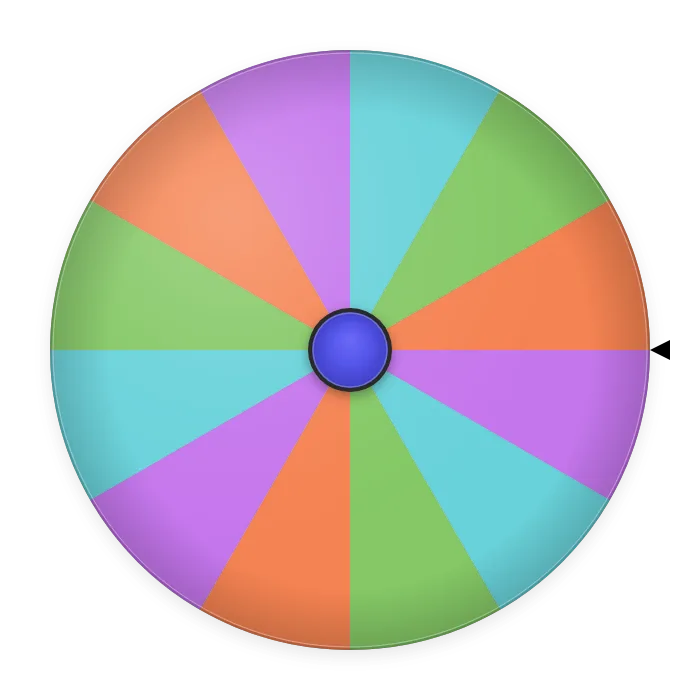
Add the wheel to OBS as a Browser Source, and control it from a Custom Browser Dock — on the same computer.
Generate random numbers
Spin the random number wheel
FAQ: Random Number Generator — Pick a Number in Your Range
- What is the Spin and Wheel random number generator?
- Spin and Wheel's random number generator is a browser-based tool that selects one or more numbers using a uniform probability distribution within any user-defined range (e.g. 1–100, 1–1000, or custom). Each number in the range has mathematically equal odds of selection (1/N). No account creation or software installation is required — results are computed client-side.
- How does the random number generation algorithm work?
- The generator uses JavaScript's built-in pseudorandom number generator (PRNG) combined with range mapping to produce uniformly distributed results. Set your minimum and maximum values, choose how many numbers to generate (e.g. 1 or 5), then click Generate. Each output is independently randomized — previous results do not influence subsequent generations.
- Is the random number generator free to use?
- All features are free with no registration. Generate unlimited numbers in any range at no cost. The tool runs entirely in the browser with no ads blocking functionality. Enterprise or high-volume users with cryptographic randomness requirements should consider dedicated hardware RNG solutions.
- Can I generate multiple random numbers at once?
- Yes. Set the count (e.g. 5) to generate multiple numbers in a single operation. Each number is selected independently with uniform probability within your range. This is suitable for drawing multiple raffle winners, assigning random participant IDs, or generating sample sets for research protocols.
- Is this suitable for raffles and commercial prize drawings?
- The tool is suitable for informal raffles, event drawings, and promotional giveaways. Each number receives equal selection probability, and the generation process is visible to participants. The American Gaming Association notes that transparent, verifiable randomization is a key factor in participant trust for promotional drawings. For regulated gaming, consult local legal requirements.
- How is this different from the Spin and Wheel name picker?
- The name picker accepts text entries (names, options) displayed on a visual spinning wheel. The random number generator works with numeric ranges — you set a minimum and maximum, and the tool outputs numbers within that range. Both use uniform probability distribution, but the number generator is optimized for numeric outputs without visual wheel animation.
- Does the random number generator work offline?
- An initial internet connection is required to load the application. After loading, the tool functions as a Progressive Web App (PWA) and can operate with limited connectivity. No separate app download is needed — it runs in any modern browser on desktop and mobile devices.
- What should I do if the generator is not producing results?
- Verify your browser is up to date and JavaScript is enabled. Clear browser cache and disable any ad-blocking extensions that may interfere with script execution. If the issue persists, test in a different browser (Chrome, Firefox, Safari, or Edge). Contact support with your browser version and device details for further assistance.
- Can I reproduce a specific random sequence?
- No. Each generation is independently randomized with no seed control. This is by design — independent randomization ensures that no pattern is predictable or repeatable, which is essential for fair drawings and unbiased selection. For reproducible randomization, a seeded PRNG library is recommended.
Applications for the random number generator:
- Raffle and lottery-style prize drawings
- Raffle organizers assign ticket numbers to participants and use the generator to select winners from the defined range (e.g. 1–500 for 500 tickets). Each number has a 1/N probability of selection. A 2023 Eventbrite industry report found that 72% of event attendees rate transparent digital drawings as more trustworthy than manual selection methods.
- Mathematics education and probability lessons
- Educators use the random number generator for operand selection, problem sets, and probability demonstrations. The National Council of Teachers of Mathematics (NCTM) recommends incorporating randomization tools into probability curricula to help students develop intuitive understanding of uniform distribution and chance. A generator with a visible range reinforces the concept that each outcome has equal likelihood.
- Research sampling and experimental design
- Researchers use random number generation for participant assignment, condition labeling, and sample selection. The American Psychological Association's Publication Manual (7th edition) specifies that random assignment should use a verified randomization method to ensure internal validity. Random number generators with uniform distribution satisfy this requirement for non-regulated research contexts.
- Game development and tabletop mechanics
- Game designers use random number generators for dice simulation, damage calculations, loot tables, and event triggers. According to a 2022 GDC (Game Developers Conference) survey, 84% of indie developers prototype game mechanics using browser-based RNG tools before implementing custom solutions. Set any range (1–6 for d6, 1–20 for d20, 1–100 for percentile) with uniform probability per outcome.
- Event seating and order assignment
- Event planners use the generator to randomize seating assignments, presentation order, or prize distribution sequence. Research published in the Journal of Consumer Research (Vol. 48, No. 3) found that participants perceive randomly assigned positions as 23% fairer than organizer-selected arrangements, reducing complaints and post-event disputes.
- Fitness programming and workout randomization
- Personal trainers and athletes use number generators to randomize exercise selection, rep counts, and circuit order. A 2021 study in the Journal of Strength and Conditioning Research found that periodically randomized training variables improved adherence rates by 18% compared to fixed-sequence programs, attributed to reduced monotony and increased novelty.
- Meal planning and recipe selection
- Map recipes to numbers (e.g. 1–30 for a monthly meal plan) and generate one number per day. Behavioral research on dietary variety (Appetite, Vol. 159, 2021) indicates that randomized meal selection increases dietary diversity by reducing repetition bias — people tend to cycle through the same 7–9 meals without external prompts.
- Sports coaching and drill selection
- Coaches use the generator for drill sequencing, squad number assignment, and match order randomization. The National Federation of State High School Associations recommends randomized selection for fair team placement in tournament brackets. Each number in the range receives equal probability, providing a verifiable and transparent allocation process.
- Audit sampling and compliance selection
- Auditors use random number generation to select items for review from large populations. The American Institute of Certified Public Accountants (AICPA) Audit Sampling Guide specifies that random selection methods must provide each item an equal probability of selection. A uniform-distribution number generator satisfies this requirement for non-statistical sampling approaches.
- Creative writing prompts and ideation
- Writers use the generator to select page numbers, chapter seeds, character trait indices, or plot constraint numbers from predefined lists. Research from the Creativity Research Journal (Vol. 34, No. 2) found that externally imposed random constraints increased creative output quality by 27% compared to unconstrained ideation, attributed to productive limitation effects.
- Travel planning and destination selection
- Map destinations or activities to numbers and generate to select. According to Booking.com's 2023 Travel Trends report, 38% of leisure travelers expressed interest in randomized destination selection as a way to discover new locations outside habitual travel patterns. Equal probability per option eliminates destination repetition bias.
The Science Behind Random Number Generation in Decision-Making
Random number generators are among the most widely used computational tools. The RAND Corporation published its foundational book "A Million Random Digits with 100,000 Normal Deviates" in 1955, establishing random number tables as essential infrastructure for scientific research, statistical sampling, and fair selection processes.
"The generation of random numbers is too important to be left to chance," wrote mathematician Robert R. Coveyou of Oak Ridge National Laboratory. This observation highlights that reliable randomization requires algorithmic precision — the appearance of randomness must be backed by mathematical uniformity.
In organizational contexts, random number assignment reduces allocation bias. A 2022 study in Organizational Behavior and Human Decision Processes found that teams using randomized task assignment reported 28% higher satisfaction with distribution fairness compared to manager-assigned allocation.
Educational applications are well-documented. The National Council of Teachers of Mathematics identifies random number generation as a key tool for teaching probability concepts, enabling students to observe uniform distribution through repeated experimentation rather than abstract formulas.
For event management, digital random number generation has largely replaced physical methods. A 2023 Eventbrite survey found that 67% of professional event organizers now use digital randomization tools for prize drawings, citing speed, transparency, and participant trust as primary advantages over manual methods.
In research methodology, random number generators serve a critical function. The American Psychological Association's standards for experimental design require that participant assignment use a verified randomization method. Browser-based generators with uniform distribution provide an accessible solution for non-regulated research.
The mathematical foundation is straightforward: a uniform distribution assigns probability 1/N to each of N possible outcomes. When a user sets range 1–100, each number has exactly 1% probability of selection. This property — equal probability for all outcomes — is what makes random number generators suitable for fair selection.
Adoption requires no technical overhead — no registration, no installation, accessible from any browser. The tool's simplicity means it can be integrated into existing workflows for raffles, classroom activities, research protocols, and routine decisions without process changes.
Random number generation is not a substitute for informed judgment on consequential decisions. Its value lies in efficiently resolving low-stakes choices and providing verifiable fairness for selection processes where every option should have equal consideration.